
Buying a Carport
RV Storage Guide
Covers RV height, roof profile, clearance, turning access, and project-specific site review.
RV Buying & Storage Guide
Protecting a high-value RV or motorhome is one of the most common reasons for building a metal structure in Northern California. The intense UV rays of the Central Valley and the heavy winter precipitation in the foothills can quickly degrade seals, roofs, and exterior finishes.
1. Calculating the "Real" Height
The most common mistake when ordering an RV cover is underestimating the required clearance.
- Measure to the Peak: Don't rely on the manufacturer's spec sheet. Measure to the highest point including AC units, satellite dishes, and antennas.
- The Buffer Rule: We recommend adding at least 2 feet of clearance to your highest point. If your RV is 12' high, order 14' legs. This provides room for error and better ventilation.
2. UV Protection & Ventilation
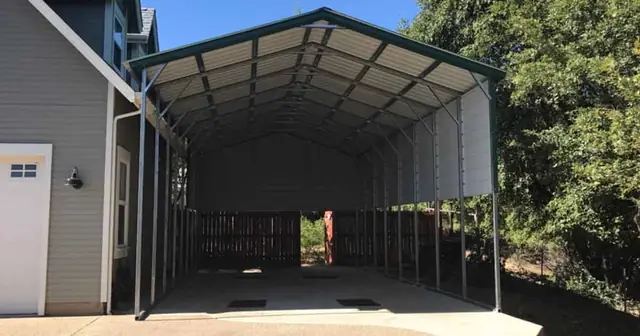
A roof-only carport is often the most practical starting point for RV storage.
- UV Block: A metal roof blocks 100% of direct sun, preventing "chalking" of fiberglass and dry-rotting of tires.
- Airflow: Keeping the sides open or partially open (with side panels) allows for cross-ventilation, preventing condensation and mold growth inside the RV.
3. Compare roof profiles
Choose a roof profile based on the product specification, appearance, panel direction, runoff planning, debris exposure, and quoted cost. A vertical panel layout may be considered for runoff or debris management, but it does not guarantee that snow or debris will clear and does not establish a wind or snow rating. Review the complete building configuration and site documents if the local authority requests a higher-load design.
4. Site Access for Large Units
RVs have a wide turning radius. Ensure your driveway and the building placement allow for easy "backing in" without having to navigate tight 90-degree turns.
Related RV Storage Examples
Tall RV covers should be compared against the actual height and length of your vehicle. The 16 x 40 x 12 vertical RV carport is a practical narrow RV starting point, while the 18 x 38 x 12 vertical RV carport and 18 x 40 x 14 vertical RV carport show wider and taller layouts for larger recreational vehicles. For more general sizing rules, pair these examples with the dimensions guide.
Technical Note: Height, enclosure, wind exposure, and other site conditions can affect frame, bracing, anchoring, and permit review. Check the proposed configuration and anchoring details for the actual property. Higher-load designs are project-specific; a standard RV cover is not automatically rated for them.

Michael Ruiz
Founder & Steel Structures Expert Northern California
Michael Ruiz started Norcal Carports to help customers compare steel-building options, prepare accurate order details, and coordinate delivery and installation with the manufacturer.
Buyer Path
What to compare next
This keeps the path moving from research into product fit, local requirements, and quote readiness.
Product
RV Covers & Motorhome Carports
Move from measurements into the existing RV cover product path.
Example
16 x 40 x 12 Vertical RV Carport
Compare a common long RV cover example with 12-foot legs.
Example
18 x 40 x 14 Vertical RV Carport
Use this taller example when AC units, antennas, or extra clearance matter.
Prep
Delivery & Installation
Confirm site access, working room, surface readiness, and install-day expectations.
Engineering review
When a project or local jurisdiction requires engineering, the ordered configuration can be reviewed for the applicable wind, snow, anchoring, and site criteria before manufacturing.
More buying a carport guides
Quote Readiness
Check fit before pricing
Use this guide to narrow the project details, then send the details that let us quote the real site instead of a generic package.