

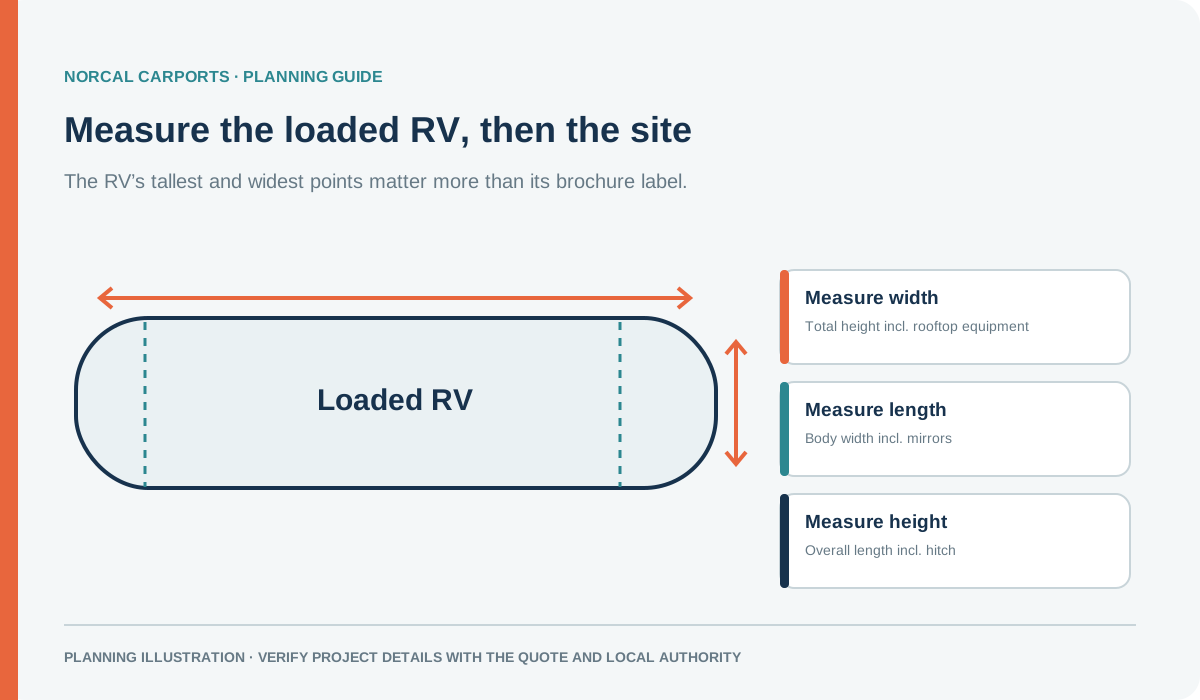
Figure note: Illustrative measurement guide. Measure the actual RV, attachments, and clear opening before choosing dimensions.
Measure the RV and the way you use it
Record the highest point with air conditioners, antennas, satellite equipment, or storage attached. Measure the widest point with mirrors in the position used when parking, and include any slide-outs that need to extend under cover. Measure overall length with the hitch or rear accessories that remain on the vehicle.
Then consider the approach path, turning room, door swing, and where you will walk around the vehicle. The usable interior space between posts and under roof framing can be smaller than the advertised outside width and height. Compare the measurement sheet with the manufacturer’s drawing for the exact configuration.
Match the structure to the property
The surface, grade, drainage, access for delivery and installation, and nearby trees or buildings can affect planning. Tell the provider whether the structure will be open-sided, partially enclosed, or connected to another building. Those choices can change the documents and local review needed for the project.
Ask the local building department about permits, setbacks, foundation requirements, and any location-specific design information before placing an order. For foothill or mountain locations, use the address-specific process in our snow-load planning guide; a citywide label is not a design value for an individual parcel.
Compare roof, frame, anchors, and documentation together
Roof profiles change the panel layout and appearance, but roof style alone does not establish wind or snow performance. Request specifications and any available calculations for the exact building, anchoring, and foundation being quoted. Ask what the documents cover and what the local authority still needs.
Compare the vertical roof system, anchor guide, and plans and calculations guide. Use the same location, dimensions, openings, surface, and installation scope when comparing providers.
What to send when requesting a quote
Provide the installation address, RV make and model, measurements of the loaded vehicle, preferred roof and side coverage, surface type, site photos, access constraints, and any permit checklist or existing site documents. Ask the quote to state the clear opening, what delivery and installation include, any site conditions that could change the price, and whether permit or engineering work is part of the quoted scope.
Use the RV storage guide to plan vehicle protection, then request a project quote with the measurements and site details.
Buyer Path
Compare Next
Use these existing pages to turn the article idea into product fit, planning details, and a quote path.
Product
RV Covers & Motorhome Carports
Compare the main RV cover product path for height, length, and side-clearance planning.
Guide
RV Storage Guide
Review RV sizing, clearance, roof pitch, and oversized vehicle planning.
Example
18 x 40 x 14 Vertical RV Carport
Use a tall vertical example for motorhome and fifth-wheel quote planning.
Quote
Request an RV Cover Quote
Send RV length, total height, AC units, slide-outs, surface type, and city.

Mike Ruiz
Founder & Steel Structures Expert Northern California
Mike Ruiz started Norcal Carports to help customers compare steel-building options, prepare accurate order details, and coordinate delivery and installation with the manufacturer.
