

An RV can be stored outdoors, beneath a breathable fitted cover, under an open-sided roof, or inside an enclosed building. The right choice depends on the storage location, access, exposure, vehicle dimensions, budget, and the maintenance instructions for the RV. No cover removes every weather risk, and no general estimate can predict repair costs for a specific vehicle.
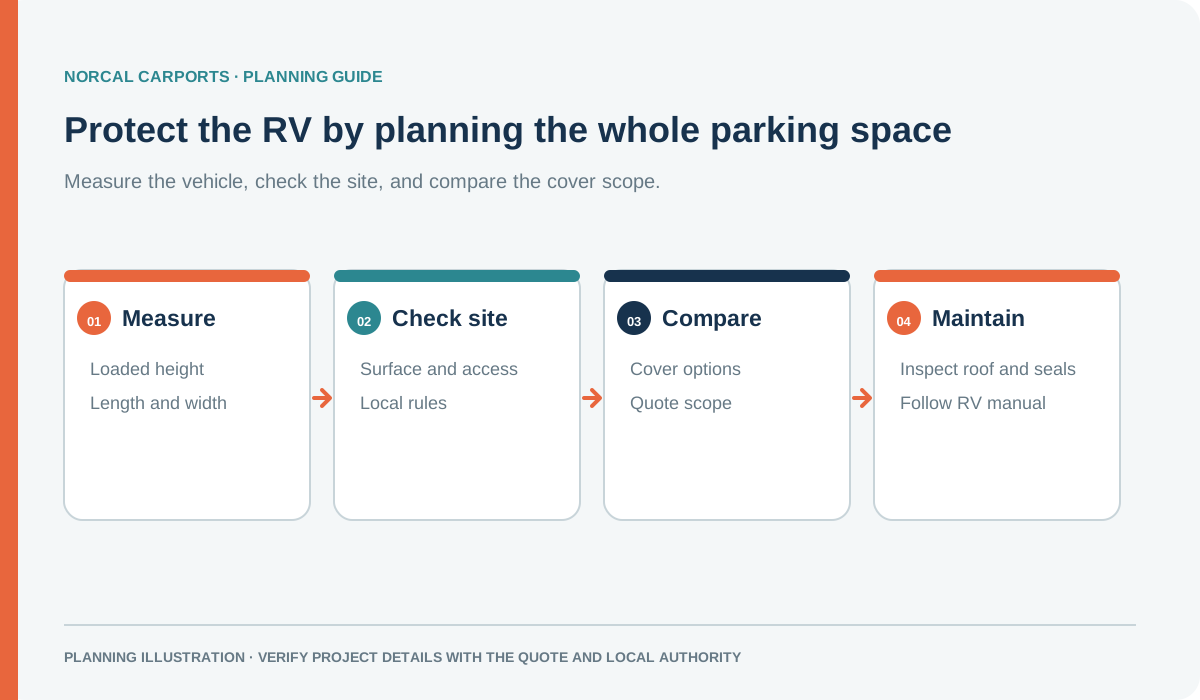
Figure note: Illustrative planning sequence; no repair-cost or vehicle-value estimate is implied.
Compare the storage choices
| Option | What it can provide | What to check | |---|---|---| | Outdoor parking | Simple access and no added structure | Sun, precipitation, debris, local parking rules, and routine RV care | | Fitted RV cover | Coverage around the vehicle without a permanent structure | Fit, ventilation, securement, abrasion points, and the RV manufacturer’s guidance | | Open-sided carport | Overhead shade and weather cover with open access | Clear height and width, wind exposure, drainage, anchoring, permits, and site requirements | | Enclosed garage | More separation from weather and a place to secure equipment | Door opening, ventilation, moisture control, access, foundation, and local approvals |
A carport roof can reduce direct exposure to sun and falling debris, but open sides do not block wind-driven rain or dust in every condition. A fitted cover also needs to match the RV and be used according to its manufacturer’s instructions. Compare the limitations as carefully as the benefits.
Size the opening around the whole RV
Measure the vehicle at its tallest point with rooftop equipment in place, its widest parking configuration, and its full length with hitch and accessories. Check the clear opening between posts, the space below roof framing, turning room, and access to doors and storage compartments. Published RV length alone does not describe the clearance needed at the site.
For a structure, request the dimensions and drawings for the exact configuration. The outside dimensions may differ from the interior opening. If the RV is changed or upgraded, recheck the clearances before assuming the existing cover still fits.
Check local requirements and the project scope
Permit, setback, foundation, and engineering requirements depend on the property and jurisdiction. Give the local building department the address and proposed structure details, then ask what documents it needs. A roof style or advertised rating is not a substitute for a site-specific review.
When comparing quotes, check whether delivery and installation are included, what “installation-ready” means for the site, and whether any nonstandard condition creates an itemized charge. Keep permits, engineering, foundations, grading, and other site work visible as separate costs unless the written quote includes them.
For sizing and location planning, see the RV carport guide, dimensions guide, and snow-load planning guide. If a roof cover fits your needs, request a project quote with your RV measurements and installation address.
Buyer Path
Compare Next
Use these existing pages to turn the article idea into product fit, planning details, and a quote path.
Product
RV Covers & Motorhome Carports
Compare the main RV cover product path for height, length, and side-clearance planning.
Guide
RV Storage Guide
Review RV sizing, clearance, roof pitch, and oversized vehicle planning.
Example
18 x 40 x 14 Vertical RV Carport
Use a tall vertical example for motorhome and fifth-wheel quote planning.
Quote
Request an RV Cover Quote
Send RV length, total height, AC units, slide-outs, surface type, and city.
Norcal Carports Editorial Team
We prepare practical planning guides using company product information and cited public sources. This article is general information and does not replace project-specific engineering or approval from the local building department.
